
by Debbie Tuma
Many people come to Montauk for its scenic beaches, famous fishing, and great bars and restaurants, but there is also a cherished treasure of Montauk history to explore, at Second House Museum. This little cottage is located at the entrance to Montauk, right on Montauk Highway, on the left as you enter the village.
Built in 1746, and rebuilt in 1797, Second House is the oldest surviving house in Montauk. First House, built near Hither Hills State Park, burned down, and Third House is owned by Suffolk County and is now a nature center, located next to the property of Deep Hollow Ranch. Second House is now owned by the Town of East Hampton and has been preserved and restored with the help of East Hampton Town Architectural Historian Bob Hefner. It also has an Indian Museum on the three acre property.
Second House Museum is known for its fascinating historical exhibits, and on June 18, they opened their newest exhibit called, “Revolutionary Montauk.” Crowds of people came to see this house transformed into what it could have looked like back in 1776.
“We have recreated the interior as it would have been in the Revolutionary times,” said Mia Certic, Executive Director of Second House Museum. “The Hand family of East Hampton lived there then, and Jacob Hand, the father, was the livestock keeper. His wife, Abigail, and his daughters, Esther, Jerusha, and Betsy, also lived there.” She said Jacob Hand went on to be the first lighthouse keeper of the Montauk Point Lighthouse. Certic said although there are no known personal writings about this period in Montauk, she wanted to tell the story of what life was like here in 1776.
“It was a very important time in Montauk. After the Battle of Long Island, all of Long Island was occupied by the British, who wanted our livestock. We had thousands of sheep and cattle in Montauk, and we had very little protection, with British battleships anchored just off our beaches. Jacob Hand managed the sheep herd.”
Walking into Second House at this new exhibit opening, a group of musicians played on the huge wrap around porch, dressed in period outfits. People filed onto the front porch and into a simple and plain living room, with a fireplace and some wooden furniture.
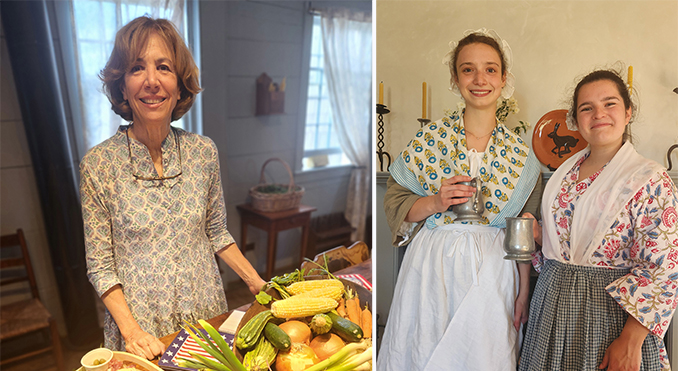
Two young women, dressed in period outfits and posing as sisters Esther and Jerusha Hand, greeted the guests. They pretended they were living in 1776. “We are wearing aprons, petticoats, bed jackets, skirts, stockings and bonnets,” explained Abigail Fitzpatrick, posing as Jerusha Hand. Dahlia Melnick, posing as Esther Hand, was answering a question of how they took a bath back in 1776. “We heat the water in a kettle on the stove, and our family takes turns bathing, from the oldest to the youngest. We only take a bath about once a month,” she said.
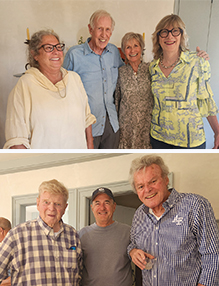
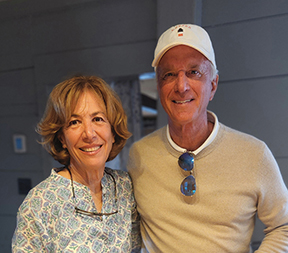
Many Montauk dignitaries showed up for the festivities. Dick White, Treasurer of the Montauk Historical Society, said he was excited that all this hard work had come to fruition. Tim Gilmartin, an honorary board member whose father, Dick Gilmartin, was the founder of the Montauk Historical Society, and mother Winnie Gilmartin was a docent at Second House Museum, flew in from his home in Colorado to visit Montauk and the museum. “I love this place—it’s been a part of my life for decades, and we’re so lucky to have it,” he said.
“Montauk has an insane amount of history, from the lighthouse commissioned in 1796 by George Washington, to the rum running days, to World War II and Camp Hero, to the one of the oldest cattle ranches in America,” said Sarah Conway, a local resident and musician.
People also gathered in the back kitchen and dining room, where they enjoyed a spread of snacks surrounded by corns and squashes which were popular foods in the 1700’s. Also in attendance were Hugh King, East Hampton Town and Village Historian; Jesse James, chairman of Second House Committee; Joe Gaviola, President of the Board of Directors; Nick Racanelli, Board Member; and Bill Akin, member of the Montauk Historical Society.
People wandered throughout the small house, comprised of a downstairs of two bedrooms, a living room, kitchen hearth and dining area, and a large crafts room upstairs, for crafting of rugs, candles and corn husk dolls. The museum houses classes and lectures throughout the year.
A more recent addition to Second House is a lovely gift shop, off the kitchen, managed by Lauren Ciardullo. She carries products themed to the era, including knitting and cook books, historical books, candles and toys, as well as souvenir post cards and T-shirts.
Second House Museum offers fun and learning for the whole family, and the “Revolutionary Montauk” exhibit is up until August 17. The museum is planning to provide programming throughout the winter. For more information, visit https://montaukhistoricalsociety.org/