
 The ocean is not an industrial zone. It is a living food system, a workplace, and a place where generations come to find peace. It feeds our families, sustains coastal communities, and connects the food chain from plankton to people. When we pound the seafloor with foundations, litter it with turbines, dredge trenches for high-voltage cables, install open-loop cooling-water intake systems and offshore substations, and flood it with construction traffic, the damage does not stop at a lease boundary. It spreads through habitat, spawning grounds, migration routes, and fisheries. What we put into the ocean can move up the food chain and ultimately come back to us.
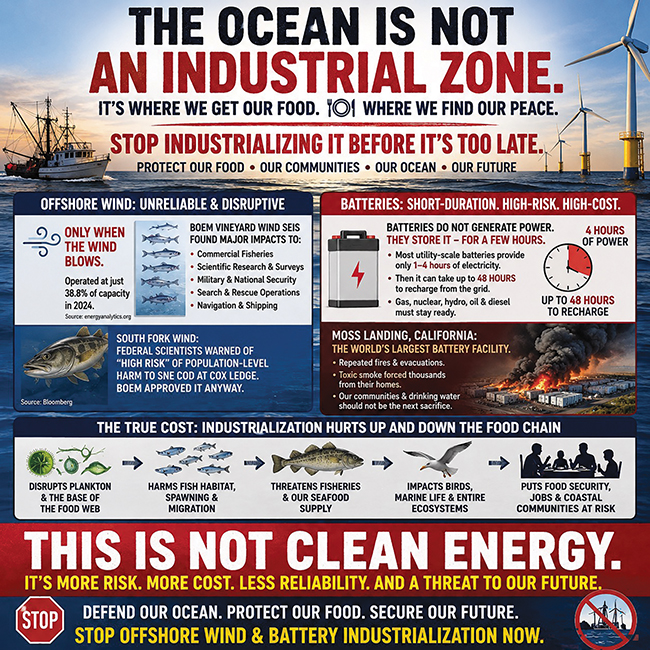
The federal government’s own Vineyard Wind supplemental review identified major impacts to commercial and charter fisheries, scientific research and surveys, navigation, military and national-security uses, and search-and-rescue operations. It also acknowledged the possible loss of commercial fishing areas. It was approved anyway. South Fork Wind Farm shows what happens when those warnings are ignored: federal scientists found a high risk of population-level harm to Southern New England Atlantic cod at Cox Ledge, it too was approved.
The industrial footprint does not remain offshore. It comes ashore through substations, high voltage transmission cables, and battery storage sites. Batteries do not generate electricity. They store it for a few hours and then must recharge from the grid. Thermal runaway can produce hydrogen fluoride and other toxic gases, while battery fires create hazardous waste, contaminated runoff, and serious risks to land and water. At Moss Landing in California, a fire damaged roughly 55 percent of 100,000 lithium-ion battery modules, burned for days, flared again, and led to the largest lithium-ion battery cleanup in EPA history.
Closer to home, PFPrA was detected in four public drinking-water wells in East Hampton. Three were removed from service, and the fourth was restricted to emergency use while the source remains under investigation. The Suffolk County Executive has demanded that the East Hampton BESS facility cease operations, while towns across Suffolk County have turned to moratoria on additional BESS development.
This is not environmental protection. We cannot industrialize the ocean, threaten our seafood, expose communities to toxic battery fires, and risk our drinking water, then call ourselves green. You do not destroy the environment to save it. We must stop before the damage becomes permanent.
~ Bonnie Brady, policy director, New England Fishermen’s Stewardship Association
For More Information, Click HERE!