
by Nancy Keeshan
What is real estate development? You find out where people are going, buy real estate there, and when there is no path, you make your own. Sounds simple, doesn’t it? It isn’t.
Real estate development takes capital, patience, a tolerance for risk, and perhaps most importantly, vision. You have to see what a place could become long before anyone else does. There is no better example of this than Montauk, where a series of bold visionaries saw potential in a remote, windswept corner of Long Island and helped create the community we know today.
The story begins with Arthur Benson, a real estate developer and president of Brooklyn Gas Light who had made his fortune in shipping. In 1879, Benson won the bid for approximately 10,000 acres of Montauk at auction for $151,000.
Benson envisioned Montauk as a private retreat for wealthy friends who could come east for hunting, fishing, and escaping the city. He built several summer cottages near Montauk Point, including the homes that became known as the Seven Sisters, designed by renowned architect Stanford White. Benson and his guests were essentially creating the first path toward a very different future for Montauk.
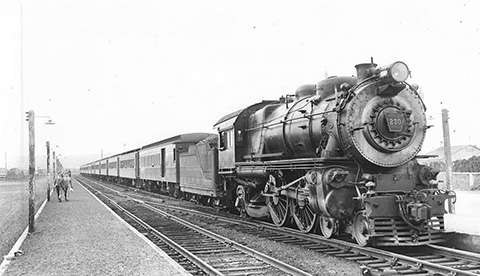 One of those guests was Austin Corbin, a railroad magnate and president of the Long Island Rail Road. Corbin saw something even bigger. He understood that Montauk’s future depended on accessibility and struck a deal with Benson to purchase approximately 5,500 acres. His vision was to connect Montauk to New York City by rail. By 1895, the railroad had reached Montauk.
Corbin had plans for even greater development, but his sudden death in a carriage accident brought those ambitions to a halt. For a time, Montauk remained largely untouched.
Then came another visionary- Carl Fisher. Fisher had already made a fortune through his Prest-O-Lite automobile headlight company and had proven that he had an unusual ability to see opportunity where others saw obstacles. In Miami Beach, he transformed what was essentially a swampy, mosquito-filled stretch of land into a glamorous resort destination.
In 1925, Fisher traveled to Montauk. What he found was a largely undeveloped 10,000-acre peninsula. What he saw was something entirely different: an opportunity to create the “Miami Beach of the North.”
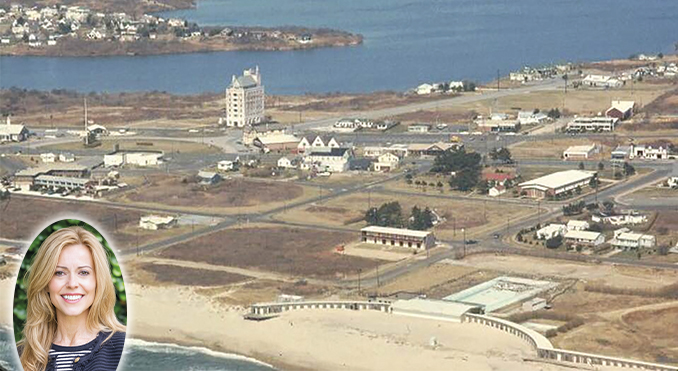
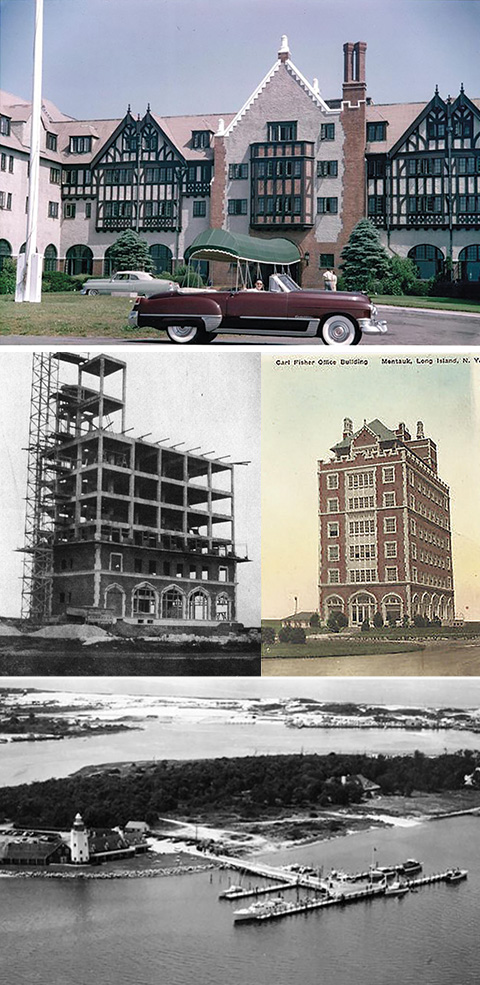 He purchased Montauk for approximately $2.5 million and began building. His projects included the Montauk Manor, and adjacent playhouse, the polo grounds, a beach club and boardwalk, the Montauk Yacht Club, a world class golf club and an iconic seven-story Montauk Tower, which today still stands in the center of the village. Fisher wasn’t simply building buildings. He was trying to build a destination—and, in doing so, he was laying the groundwork for the Montauk we know today.
Then, in 1929, the Great Depression changed everything. Fisher’s financial backers were wiped out, land sales collapsed, and his ambitious vision came to an abrupt end. He eventually returned to Miami, where he lived quietly until his death in 1939.
Looking back, Benson, Corbin, and Fisher all recognized something that is still evident today: Montauk has a certain magic! Benson saw a private retreat. Corbin saw a place that could be connected to the city. Fisher saw a world-class resort. Each man saw a different future, but together their visions helped shape the Montauk of today.
Perhaps that is what real estate development is really about. It’s not simply buying land, putting up buildings, or following where people are already going. It’s having the courage to imagine what isn’t there yet—and then taking the risk to make it real.
Carl Fisher was absolutely right about Montauk. He was simply about 100 years too early. Today, I love the unique Fisher buildings that remain and give Montauk so much of its character. They are reminders of a time when one man’s vision could reshape an entire community.
Just a few years ago, we honored that vision by renaming the Plaza in the village Carl Fisher Plaza—a fitting tribute to a developer who understood something very special about Montauk long before the rest of the world caught on. He saw the path before it existed and he had the courage to build it.