

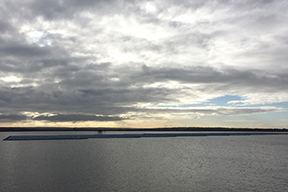
Dear EarthTalk: Is it true that we could meet all of our electricity needs in the U.S. with floating solar panels on reservoirs and other water bodies across the country? ~ P.L., via e-mail
Energy usage in the U.S. has surged in recent years, with electric power sector 96 percent of the country’s utility-scale electricity. To address this, floatovoltaics—solar panel systems that float on water—have the potential to combat growing energy demands. “Floatovoltaics are one of the fastest-growing power generation technologies today and a promising low-carbon energy source,” University of Texas aquatic ecosystem ecologist Rafael Almeida told Eos.
Floating solar farms operate similarly to ground-mounted farms. Devices keeping the system buoyant sit on top of the water, cooling the panels, which increases efficiency. Also, using water surfaces frees up land for other uses. Germany, Russia and China are already benefiting from floating solar farms, suggesting that the U.S. could follow suit.
However, implementing floatovoltaics has issues. As the idea is relatively new, long-term durability is uncertain. Harsh weather, declining performance and maintenance needs must be studied as systems age. Connecting from water to land adds more complexity, as scientists must ensure efficient power transmission. With time will come a better understanding of the potential to implement them nationwide.
But floatovoltaics do show great promise, though they are unlikely to meet all of the U.S. energy needs alone. Waterbody availability, environmental and logistical concerns mean that floating solar farms could be a complementary solution rather than a standalone one. More research on renewable energy, along with careful system design, will be need to ensure successful implementation. When combined with other efforts, floatovoltaics could help reduce reliance on fossil fuels and meet a large portion of U.S. energy demands. “On one hand, we can’t put too many barriers to this potentially important sector to advance,” Almeida added. “But on the other hand, we need to understand the trade-offs and fill our prevailing knowledge gaps with more studies.”
Floatovoltaics present a revolutionary approach to addressing the U.S. energy needs. Through more research and design, these systems could become key in future renewable energy solutions. Support the adoption of renewable technologies by engaging with community leaders, advocating for local initiatives, and supporting green energy providers. By staying informed and spreading awareness about innovations like floating solar farms, you can help shape the future of renewable energy in the United States.
MORE INFORMATION: theenergymix.com/floatovoltaics-hold-promise-but-ecosystem-impacts-still-under-review/.
♦ ♦ ♦ ♦ ♦ ♦ ♦ ♦ ♦ ♦ ♦ ♦

Dear EarthTalk: Are we already noticing significant biodiversity shifts or losses as a result of climate change in recent decades? ~ J.D., Loveland, CO
Climate change is not the only reason we have suffered huge biodiversity losses in recent years, but it has played a part in the shifts and declines of species that many ecosystems have faced. Other human activity like habitat destruction, overexploitation of resources, and invasive species introduction have also had an impact. But climate change has become a more significant cause of biodiversity loss in recent years.
The Great Barrier Reef, which is especially vulnerable to rising temperatures, has already suffered biodiversity losses from climate change. The northern parts of the reef—often regarded as one of the most biodiverse habitats on the planet—have changed in the last three decades, with many fish going extinct. The reef depends on its diversity of coral to attract a wide variety of fish, but higher ocean temperatures have killed many types of coral already in a process called bleaching. “Bleaching is a stress response by coral, which have tiny microscope algae inside their tissue,” said Coral scientist Terry Hughes in a TED Talk. “Those algae give the coral its color and they are important for the nutrition of the coral. When bleaching occurs, the algae are depleted and the coral itself becomes nutritionally compromised.”
On land, some animals have been driven north or to higher altitudes to escape the heat. As a result, plant species left behind have fewer animals to disperse their seeds and sustain their native habitats. Climate change has also thrown off species’ seasonal clocks, which help them time their behaviors with the cyclical nature of the seasons. “Since every organism’s seasonal clock is affected differently by different phenological cues, such as precipitation, temperature or sunlight, it’s very difficult to predict how each organism is going to respond to climate change,” said botanist and ecologist Liana May in an educational YouTube video by Nature Change. Because of their differing cues, some flowers may bloom before their pollinators come out of hibernation and birds may migrate at the wrong time.
Scientists have identified the links between climate change and biodiversity loss, and recognize that addressing one will help the other, and vice versa. Specifically, reducing the effects of climate change allows for the restoration of natural habitats and the reintroduction of native species, and preventing biodiversity loss can keep natural habitats healthier and more capable of absorbing carbon emissions. Focusing on both biodiversity loss and climate change together may be the key to saving thousands of species, and to keeping our natural habitats healthy.
MORE INFORMATION: lancaster.ac.uk/news/great-barrier-reef-fish-evidence-suggests-shifts-in-major-global-biodiversity-patterns; pmc.ncbi.nlm.nih.gov/articles/PMC9058818/; besjournals.onlinelibrary.wiley.com/doi/10.1111/1365-2664.13985.
♦ ♦ ♦ ♦ ♦ ♦ ♦ ♦ ♦ ♦ ♦ ♦

Dear EarthTalk: Why is allergy season longer and more intense lately? ~ Sneezing in Snohomish
During springtime, many people develop a series of symptoms generalized as seasonal allergies: coughing, sneezing, itchy eyes and congestion, just to name a few. These symptoms are widespread; in 2024, the Asthma and Allergy Foundation of America reported that some 81 million people in the U.S. suffer from seasonal allergies. This number is growing as symptoms are becoming more intense and allergy season is getting longer.
The cause of these allergies comes down to one product of flowering plants: pollen. This substance becomes more prevalent during the springtime, when the warm weather triggers flowers to open up. When pollen accumulates to high levels in the air, humans can develop an immune system response that leads to a physical reaction. The problem is that the air is getting warmer, and plants are producing pollen for a longer duration and in larger amounts than before. “A longer growing season means the plants have more time to produce pollen,” says Dr. Rana Misiak, an allergy specialist at Henry Ford Health. “And that results in pollen circulating in the air for a longer period of time.” In addition, droughts and dry weather can cause more pollen production, along with higher levels of carbon dioxide in the atmosphere. Air pollutants such as carbon dioxide damage the surface of the pollen, making it more allergenic.
Pollen production is heightened by climate change. Human activities are causing global temperatures to rise, subsequently worsening allergy season for many. “To me, [worsening allergies] highlight the fact that our health—even if you just have a pollen allergy—is being impacted by climate change,” says Mary Margaret Johnson, MD, PhD, a research scientist of environmental health at Harvard T.H. Chan School of Public Health. “And some have much more severe health consequences from climate change.” This means that the health of an individual is somewhat out of their hands—it is up to climate change to determine the severity of their allergies.
Taking action to reduce collective carbon emissions and effectively slow the rise of global temperatures will help minimize symptoms felt by allergy season. There are also many studies now being conducted, like the Citizen Science HD’s Pollen Nation Project at Emory University or the National Phrenology Network, that allow civilian participation. If you are interested, you can learn more about these studies and contribute data towards their findings. In addition, any action to reduce your personal carbon footprint or advocate for pro-climate legislation will help to improve the current conditions of seasonal allergies.
MORE INFORMATION: aamc.org/news/do-seasonal-allergies-seem-be-getting-worse-blame-climate-change; bu.edu/articles/2023/seasonal-allergies-are-worse-this-year-what-you-can-do.
♦ ♦ ♦ ♦ ♦ ♦ ♦ ♦ ♦ ♦ ♦ ♦
EarthTalk® is produced by Roddy Scheer & Doug Moss for the 501(c)3 nonprofit EarthTalk. See more at https://emagazine.com. To donate, visit https://earthtalk.org. Send questions to: question@earthtalk.org.