
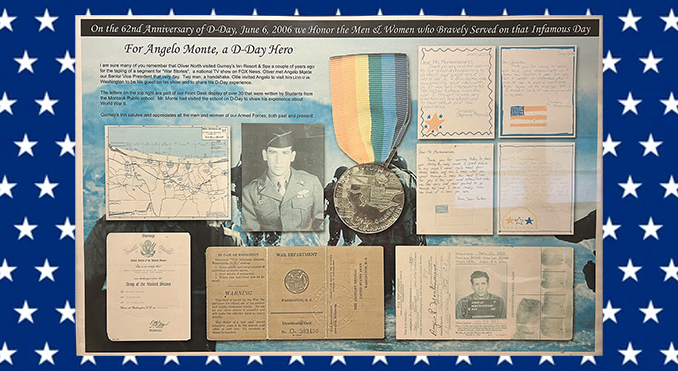
by John Lomitola
Picture this: it’s one week after the bombing of Pearl Harbor on December 7, 1941, and many of your friends and family are heading down to the various recruitment offices around Brooklyn, your hometown. You too feel it’s your duty to follow the call to serve your country, and you find out that the closest local military recruitment office in your neighborhood is for the U.S. Marine Corps. “What the heck,” you say, and wander in to sign up like any young twentysomething man would do in times like this.
This was the destiny of my wise-ass, 22-year-old future father-in-law, Angelo Montemarano, a gifted neighborhood Italian Stallion prizefighter, who once told me that he had two fights daily: one on his way to school through the Irish neighborhood, and one on the return home.
Angelo was the fifth of seven boys, born to Angelo and Filomena Montemarano of Carroll Gardens in Brooklyn. All of the children were born in the family apartment building, above the family-owned restaurant called Monte’s Venetian Room. Filomena was brought to this country from Avellino, Italy, as a bride for Angelo Sr., who had already been in this country since childhood. 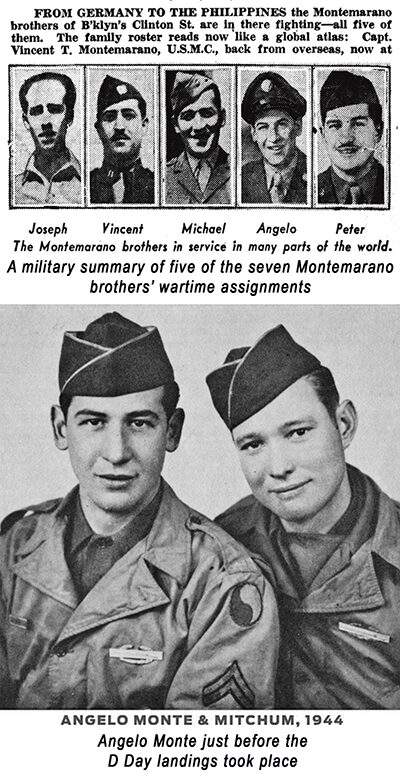 To make ends meet, and before they were able to save enough to buy the apartment building, they opened a small sidewalk eatery, serving basic Italian eats to the local longshoremen wandering around from the dock area near the Gowanus Canal. Soon, word got out about Filomena’s tomato sauce, which was, by most standards, simply outstanding—so, as the children got older, Angelo Sr. opened Monte’s Venetian Room Restaurant and put all the children to work together as a family affair.
As luck would have it, my future father-in-law, Angelo Jr., was a tough, solidly built, energetic young man with a broken nose, the remnant of his prizefighting days, and his solid arms—the left one he called “the hospital” and the right one “the cemetery”—were legendary! So, he made it through U.S. Marine basic training with flying colors, until the final physical exam, where the doctors told him he had flat feet and had to be discharged. Not to be outdone, he simply waited a few days and went down to the U.S. Army recruitment office, and signed up without a hitch. Any other basic training after the one he passed while in the Marines was a breeze for him, and he entered service as a PFC.
While Angelo Jr. was waiting to be deployed somewhere in the Pacific, as he expected, war in Europe was heating up rapidly, and the Nazis were conquering most of Europe in search of “Lebensraum,” or loosely, “Habitat.”
 Soon enough, Angelo was deployed to a staging area located in the British Isles in preparation for the invasion of Europe. That much was known to just about everyone, but through an elaborate series of deceptions, and the breaking of the super-secretive German Enigma Code by the famous ladies of Bletchley Park in England, the actual invasion location and date remained obscured to the leadership of the German Wehrmacht. And Herr Hitler, Der Führer himself, took over direct control of the German armed forces under his command, which turned out to be a huge unforced error.
The final preparations were made, and the night of June 5, 1944, was chosen as D-Day for the invasion, and Normandy would be the destination. But a huge storm was brewing, and the U.S. Military leadership postponed the invasion by one day to begin on June 6, 1944.
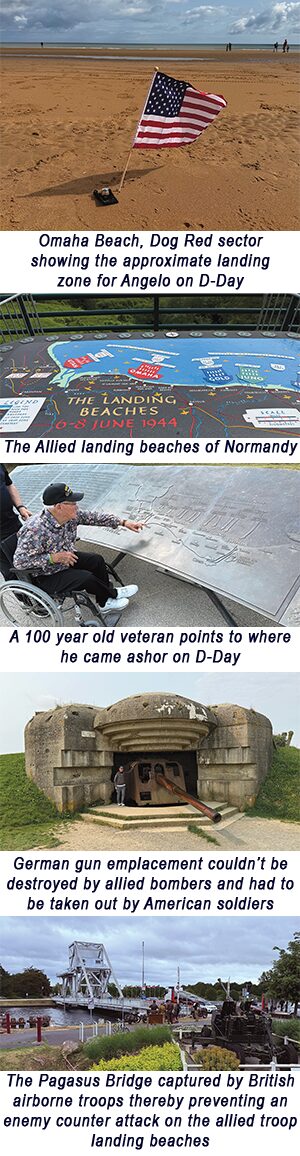
All the soldiers were loaded into transport vessels for the early morning crossing, which turned out to be almost as rough as the night before. Angelo was assigned to a Higgins Boat Landing Craft vehicle where he and his buddies, about 36 men, were crammed in with all their gear. The voyage was no all-inclusive luxury cruise, but rather “hell in a shell,” as some have described it. The English Channel can get as rough as the Atlantic Ocean at times, and this night was no exception. Soldiers were throwing up, and the rough seas made sleeping virtually impossible.  After what seemed like an eternity crossing the channel, a dark horizon came into view through the backlit explosions from ordnance dropped by the Allies on the enemy gun emplacements. Although the Germans were taken totally by surprise, they rallied, and gunfire started to pepper the seas surrounding the Higgins Boats as they approached the shoreline. They were to disembark on Omaha Beach, Dog Red sector, in the first wave of landings. Suddenly, they got hit by a lucky shot from shore, and those who survived were thrown into the water. Angelo started to sink from the weight of his 60-lb backpack, and in the process of slipping out of it, lost his rifle as well—but that move saved his life. Now he was faced with a 150-yd crawl over a ridiculously flat, hard sand beach under live fire without his weapon. After crawling through all the gunfire, he made it safely to the sand dune and curled up in the fetal position. Finally, some random soldier got up and shouted, “Follow me,” and promptly got shot. A second guy got up and shouted the same, and this time Angelo grabbed a discarded rifle from the sand and proceeded to follow until they made it to safety up the hill further on.
Hence, this magnificent and terrifying beginning of the end of the Third Reich led to the incredible life I had with my wife, Phyllis, Angelo’s daughter, who was born a few years after his safe return to his home in Brooklyn. Had he not survived on that miserable day, my life would never have been the same.
 I’ve always felt a burning desire to celebrate this man’s incredible story, and it all came to fruition when the TV star Oliver North came to our family’s business, Gurney’s Inn Resort in Montauk, NY, to do a segment of his successful series War Stories. Ollie, as he was known, was invited to interview some local WWII veterans, and he was told by our marketing director, Ingrid Lemme, that Angelo Peter Montemarano was a D-Day survivor. That made Ollie even more interested to commit to the filming at our resort. It was only then, during the actual interview, that we all learned about Angelo’s incredible heroism and good fortune. Before that, he never said a word about his wartime service, simply commenting that it was too horrible to speak about.
I immediately set about formulating a plan for a visit to the beaches of Normandy for the 81st anniversary on June 6, 2025, where the Allied Liberation of Europe began by most accounts.
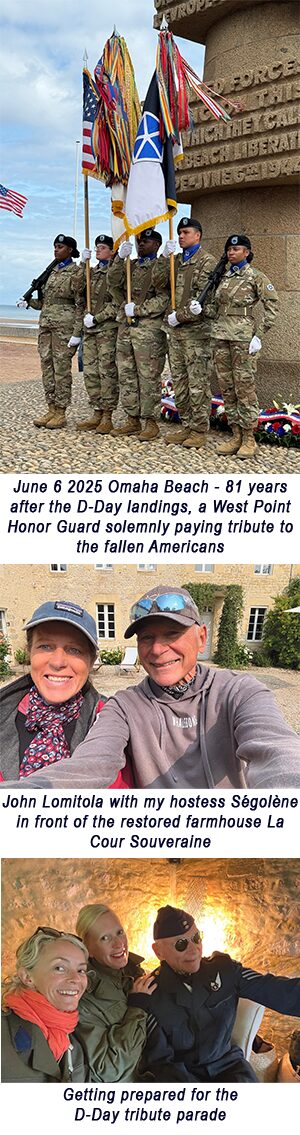
In order to prepare for my mission of paying tribute to my hero father-in-law, I opened Google Maps and searched for Omaha Beach, Normandy. After finding that, I simply looked at what was shown to be small B&Bs, family hotels, and farm stays. One of them looked 6 km away—close enough to the beaches to walk, I thought, so I began emailing. As luck would have it, the first to respond was Le Cour Souveraine (The Sovereign Court), a totally reconstructed period farmhouse from the turn of the century. My good fortune continued when I met the owners for the first time, Ségolène and José Luis, who turned out to be the most incredible hosts, caring for me in a way that only family would know how to do. My most basic language skills in French were a vestige of four years at LaSalle Academy in Manhattan, with only the Hail Mary prayer left in the recesses of my brain. We had a good laugh after I recited the prayer to them and continued our conversations in beautifully accented English.
As soon as they realized the purpose of my mission and tribute, they leapt into action, laying out all the possibilities of accessing the famous beaches and museums. My first goal was to find the Dog Red sector of the Omaha Beach landing zone, and on June 6, I proceeded to walk from the Overlord Museum—a must for any history buff—to the American Cemetery and then the beaches below the cliffs.
 The visceral experience of actually walking on this sacred ground, where tens of thousands of brave Allied troops were killed or wounded, where chaos ruled and luck hovered ever so quietly over the conundrum of who would survive and who wouldn’t, was overwhelming, and I couldn’t stop the flow of emotion in this moment.
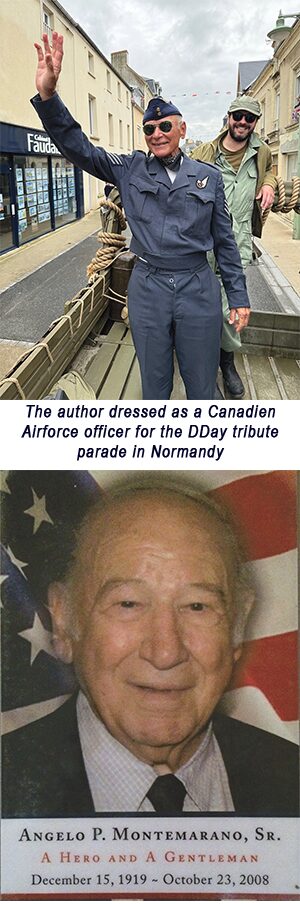
When I returned to my farm stay that evening, Ségolène handed me an authentic military uniform of a Canadian Air Force officer (an integral part of the Allied Expeditionary Forces) and invited me to take part in an annual military parade in the morning, in a convoy of authentic military vehicles through the villages along the Normandy coast that were among the first to be liberated. The uniform fit me like a glove, and several of the other guests who took part dressed in military fatigues, while Ségolène became a battlefield nurse. So, off we went in a half-ton American Jeep, and joined up with Sherman tanks, Deuce-and-a-Halfs, LCT landing craft, Halftracks, and Military Police motorcycles—barreling down the small highways from Pointe du Hoc to the Omaha Beach landing zone. I was joined by Sophie and Claire, two cousins, beautiful souls, and guests of our farm stay, who rode in my vehicle dressed as American Women’s Voluntary Services personnel. Keep in mind that hundreds of local citizens lined the streets along our route, shouting, taking photos, and flashing the peace sign as we lumbered past them. I was awestruck at the depth of the French citizens’ appreciation of the sacrifices that led to their country being the first to be liberated, and the demise of the enemy’s occupation of Europe.
My father-in-law, Angelo Peter Montemarano, will forever live on in our family’s heart for his incredible service and the sacrifice that so many others had to make and who never returned. We are the lucky ones who will always be indebted to him, as his survival changed the lives of many—especially my own.