

Hamnet by Maggie O’Farrell
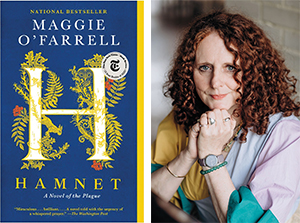 Maggie O’Farrell’s 2020 historical fiction novel, Hamnet, imagines the life and tragic death of William Shakespeare and Agnes Hathaway’s son, Hamnet, who died in 1596 at age 11.
William, never named in the novel, falls in love and marries an older, free-spirited Agnes, and they have 3 children: Susanna and twins Hamnet and Judith. The younger William becomes disillusioned with working for his father’s glove company and, on the encouragement of his wife, moves to London, leaving Agnes to raise the children at his parents’ home in the countryside. As his interests develop elsewhere, he prolongs his time away to build his career as a playwright.
Although a work of fiction, the book benefits from O’Farrell’s deep historical research, successfully and creatively reconstructing gaps in Hamlet’s early life. Her interpretation of the events that follow keeps the reader engaged and engrossed in the tragedy, similar to reading Hamlet.
Core themes are explored throughout: Grief and sorrow, as O’Farrell contrasts a mother’s outward, grounded grief with a father’s internalized, creative channeling of pain. Family dynamics are another, as we see the lasting effects of the constant bullying William faced from his father, as well as the rift that deepens between Agnes- portrayed as an intuitive, nature-connected herbalist- and her traditional mother-in-law.
By weaving historical context into the narrative, O’Farrell gives readers a rich foundation to follow the evolving plot. Below are a few noted connections that you may or may not want to read until you complete the novel. Furthermore, the novel was adapted into a 2025 feature film that is widely available across major streaming platforms
For additional information about Maggie O’Farrell and her books, go to: https://www.maggieofarrell.com/
Historical connections:
–Hamnet Shakespeare was born in Stratford-upon-Avon in 1585 as the twin to his sister Judith, following their older sister Susanna. They were named after family friends, Hamnet and Judith Sadler
-Although the book suggests that Judith was ill, yet ends up surviving and Hamnet dies, historically, there is no record that Judith was sick when Hamnet died, nor is there any surviving document specifying what illness killed Hamnet. The parish register of Holy Trinity Church in Stratford-upon-Avon simply notes Hamnet’s burial on August 11, 1596, without listing a cause of death.
-A few years after Hamnet’s death (Hamnet died in 1596, and Shakespeare composed Hamlet roughly three to five years later, between 1599 and 1601), William writes the famous tragedy, Hamlet, which was interchangeable with “Hamnet” at the time. Suggesting that the grieving son and ghostly father serve as a way for the playwright to process his grief and immortalize his lost son.