
by Evelyn J. Mocbeichel
It’s been publicized for almost a year now that the United States Mint will stop producing the penny. Why is this happening? It has been explained that it costs almost two to three times the face value of the coin to actually make it. The annual cost savings by eliminating a coin of a one cent face value that costs three cents to make has been estimated to be about $56 million dollars a year to the U.S. Government. The last coins to be made were in November 2025 at the Philadelphia Mint. How any of us have a large jar or candy dish filled with collected pennies stored somewhere at home? Perhaps some people are considering holding on to them as “collector’s items”, while others feel millions of households will be doing the same, so the value will decrease for being a rare item. What I did notice while shopping last week when my small purchase came to a few dollars and coins coming to 52 cents. The clerk told me, “Just give me the fifty cents, and don’t worry about the two pennies.” This surprised me as the store was losing money on their end. Did they feel it was a nuisance now to deal with pennies or was there a shortage already showing up?
Penny History… Actually, the proper word for this coin is called “cent.” The word penny, which most of us use to this day, comes from the United Kingdom. The British people called their lowest demonization coin the penny, so the same word came to be adopted here in the United States too. Both names are interchangeable and correct.
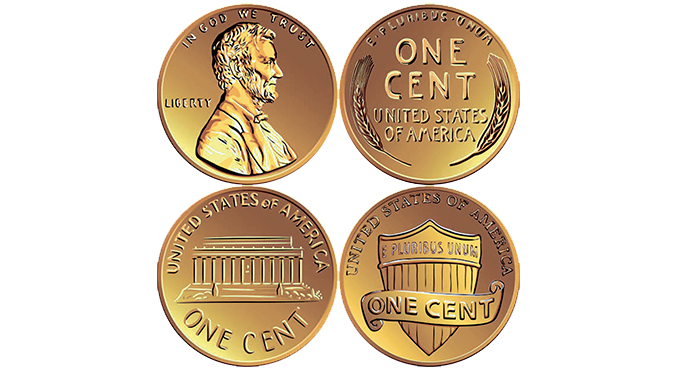
The first penny was made by the U.S. Mint back in 1792 under the Coinage Act. Originally the first design was of a woman with long flowing hair that was the symbol of Liberty. Then in 1909 the design was changed to honor President Abraham Lincoln to commemorate what would have been his 100th birthday That front design remains to this day. However, the reverse has been changed several times over the decades. Lincoln was the first President to have his image placed on a U.S. coin. The original penny was made of 100% copper until 1857 when nickel was added to make it more durable and decreased costs for production. I am sure back in those days the penny was used frequently for purchases. Readers of a certain age will even remember the penny being the coin for single piece candy purchases or from a gumball machine back in the 1950’s and early 1960’s. Also, back in the day, that was the cost of a stamp to send a postcard domestically.
When World War II started, copper was needed for airplanes, ammunition, tanks, wiring and other vital parts. So, in 1943 a steel penny was produced with zinc coated steel. After the war copper was added back into the composition with 95% copper being used until 1982 when it was reformulated once again. Therefore, any pennies made after 1982 are 95% zinc with 5% copper planchet, which is basically a blank metal disk.
However, for those amateur collectors out there, here is a mini tip about pennies made of full copper. In 1943, before production switched to steel pennies, the Mint accidentally made some 1943 dated copper pennies. These rare coins are highly valuable today and perhaps worth looking out for the next time you get some pennies as change! Speaking of mints, there are four locations in the United States and they are Philadelphia, Denver, San Francisco and West Point, NY. Each mint produces a different coin. But the San Francisco and West Point facilities are focused on creating high-quality sets for collectors and producing ones made of precious metals like gold and silver. As with much of what we have seen in these last decades changes are reflecting different needs and lifestyles. I am sure when the penny becomes rarer in daily use, it will be noticeably missed. Perhaps a bit of nostalgia might set in to some of us.