
How a Personal Tragedy Turned into the Walk of a Lifetime
by John Lomitola
It all happened so quickly, the last few weeks, crushing the hope that somehow she would make a miraculous comeback, as she had done the previous two times she had been diagnosed with cancer. October 20, 2024, marked the day that Phyllis, my wife of 47 years, left us to ascend to a better world—in our faith, one that is never-ending and filled with eternal love.
While throughout these moments of tremendous sadness and soul-wrenching pain, I promised her that I would continue my life as she would have wanted me to—with the focus on fulfilling our ‘bucket list’ dreams that we had meticulously planned to do together until life got in the way. We loved to travel with each other, and it seemed we were at our happiest visiting exotic places, sampling cuisine, and experiencing local customs and lore. Phyllis brought strength, curiosity, and fortitude to our marriage, and I was adept at picking up languages, learning how to fit in, and quickly making friends.
We had traveled together to places many people couldn’t find on a map, including Tahiti, New Zealand, Australia, China, Argentina, Ecuador, and Western Europe, with a concentration on our roots in Austria and Italy. Our expanded list of places to visit—but not yet attained—included Bhutan, Iceland, Colombia, and Scandinavia. But high up on our bucket list was The Camino Santiago de Compostela, a pilgrimage of sorts in northern Spain that we became interested in after watching the movie “The Way,” with Martin Sheen.
While watching Sheen’s character, ‘Tom’, we became enamored with the concept of walking the trek that Tom’s estranged son had begun but couldn’t complete when he died. Tom traveled to France to retrieve the body, but as soon as he figured out his son’s mission, he resolved to take the journey himself, in an effort to understand both himself and his son.
The Camino Santiago actually began about 1,000 years ago, when the sacred remains of Jesus’s apostle James were found in a field in Galicia by a shepherd named Pelayo in the 9th century, during the reign of King Alfonso II. The King then built a small chapel over this holy place to commemorate St. James and later commissioned a larger temple in order to attract pilgrims from all over the world.
Martin Sheen’s character actually walked from the Pyrenees mountains to Santiago de Compostela, a journey of more than 700 km. Phyllis and I promised each other that we would attempt to complete the minimum distance of 100 km required to achieve the ‘ticket to heaven’ once you reach the Cathedral of Santiago. In Phyllis’s honor, I carried a small urn with her ashes the partial length of the Camino Francés, between the town of Sarria and Santiago de Compostela—for a total of around 120 km, including the various detours and extensions offered on the trail.
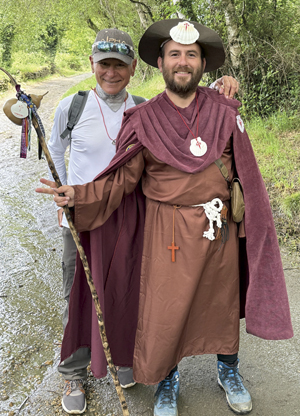
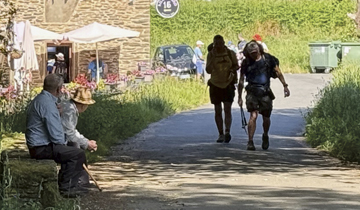
Although I walked the Camino alone, you’re never really alone, as there are hundreds of other pilgrims trekking the routes, for all reasons—all in sync with some inner force that is driving their individual pursuits. I tasked myself with trying to connect spiritually to Phyllis, with the goal of seeking to develop a sort of celestial communication with her spirit through prayer and meditation. Much of the Camino wanders through fields, forests, and medieval villages that reminded me of scenes out of the landscape of Don Quixote and Sancho Panza. It was the perfect environment for me to quietly reflect on our fortunate life together and the blessings we had received that allowed us to actually fall in love with each other—a foundation that carried us through the ups and downs of married life.
I began the Camino on May 23, 2025, and arrived at the Cathedral of Santiago on May 29, 2025, for a total of six days of walking the distance. The actual route is very well marked, giving pilgrims confidence at any diverging point as to which way to go. Much of the Camino during springtime was a riot of wildflower colors and a cacophony of songbirds and waterfowl vying for the chance to find a mate and start a family. The pathway at times led over Roman Empire–era bridges, across cow pastures, through rolling farmlands, and dense groves of wild chestnut trees. Sometimes, a spontaneous rivulet would cross the path, shallow enough to wade through without much thought—except for the magnificence of nature.
Nights can be spent camping, staying in the many dormitory-style Albergues along the way, or—as I did—staying at small family-owned 1–2 star hotels, often converted farmhouses or medieval structures that have been renovated. These are very comfortable and usually offer a typical breakfast of fruit, cheese, yogurt, coffee, and jamón (local thinly sliced ham). It wasn’t too difficult for me, a pescatarian, to find enough nourishment to walk the required 14–20 miles daily, but I had to remind myself to stay fully hydrated throughout the day. Bringing a water bladder in a small backpack is essential, and there are plenty of fountains along the way with pure, spring-fed drinking water to fill up.
Of all the quiet solitude, the natural symphony of nature’s sounds wafted quietly through the air as a constant companion to ease the cluttered mind of things that would normally distract us on a typical day at home. There is no need for cell phones to check social media or current news blasts, as the energy of the Camino is ever-present as a constant reminder of the power of connection to a spiritual source. My reflections were focused on trying to quiet myself so as to be more receptive to anything that might offer answers to why my life took the turns that it did. Why did my soulmate, best friend, mother of our two children, grandmother of our five grandkids, and the love of my life get called on to depart this world?
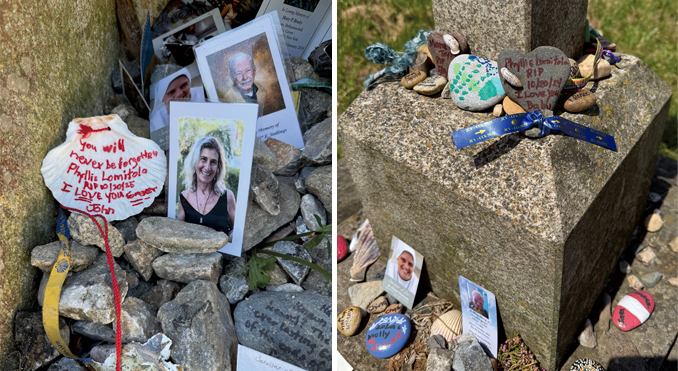
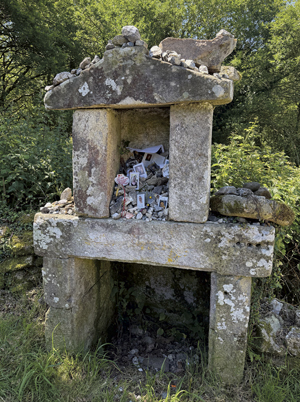
The Camino silently offered plenty of answers, although not always the ones I expected or desired. The grief, the pain of losing someone so close to you—the person you automatically reach out to, through thoughts and deeds—made it inexplicable and inconsolably confusing. I needed this time alone to explore all the avenues that this meditative state on the Camino offered to me. The pathway led me past many religious grottos, memorials, chapels, and healing fountains, where I quickly figured out that I could honor my wife Phyllis by leaving several tributes to her as a remembrance at these shrines for all to see. Also as important was the prospect of trying to figure out who the new me was going to be, and how I would develop alone—without the security of knowing she was around to turn to for loving support. That, being equally as difficult, is turning out to be a life’s work in progress, without her by my side.
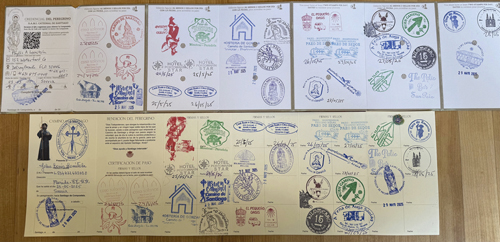
On my final days, I made it to Santiago de Compostela intact, stronger than when I started, and full of satisfaction that I had fulfilled a portion of our bucket list—with Phyllis in the urn. Upon reaching the Cathedral, there are plenty of pilgrims queuing up to receive the ‘spiritual blessing’, and the church had it very well organized. You come into a line of PCs, where you enter your name and start date, along with your proof of your walk, which is your ‘passbook’ with all the stamps you’ve accumulated along the way. As I was entering Phyllis’s info after mine, a man approached me and asked where this other person was, as they have to be physically present to attain the blessing. I panicked and suddenly blurted out that “It’s for my wife Phyllis, she died, but she’s with me,” as I reached into my pocket and pulled out the tiny urn with her ashes in it. Tears were starting to stream down my face, as I faced the prospect of not accomplishing our stated goal because of a technicality.
The man grabbed me by the arm and led me to a back room filled with ladies on computers pumping out Compostelas, or official blessings from the church. He said a few words to them in local Galician dialect, and suddenly the ladies got up one by one and came over and hugged me, each saying something I assumed meant “Sorry for your loss—don’t worry!” In my moment of confusion, I wanted to explode with overwhelming joy.
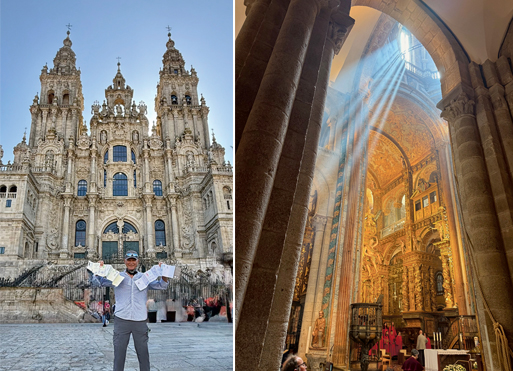
I was ultimately granted the Compostela for both of us, and needless to say, I felt a huge swelling in my heart, filled with satisfaction at my accomplishment and the tribute paid to the love of my life, my dear, sweet Phyllis. I ran out of the church and stopped the first person I saw to snap a photo of me with the documents in front of the Cathedral. It happened to be Ascension Thursday, and there was a special mass starting in a few minutes. I walked into the church to witness over a thousand people in attendance—a fitting end to a life-changing experience.
For more information and Camino Santiago resources, click HERE.