

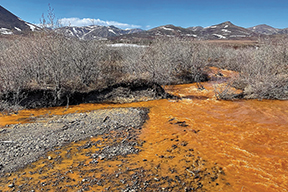
Dear EarthTalk: Why are Arctic rivers and streams turning orange? – Will Mortimer, Largo, FL
Over the past decade, an increasing number of orange rivers and streams have been found in Arctic Alaska’s Brooks Range. These waters tend to be more acidic, turbid, and have higher concentrations of iron than their clearwater counterparts. As the Brooks Range is one of the least populated regions of North America, the typical cause of coloration of these water sources, namely excessive mining, is not probable.
More broadly, these orange rivers and streams are part of the Arctic Network, a larger regional area containing 19.3 million acres of land. In 2018, the National Park Service received reports of one of the first orange streams in the Brooks Range. By utilizing crowd-sourced observations from bush pilots, wilderness guides, other scientists, and rural and Indigenous communities, they found that over 75 streams had become orange in the Arctic Network. The findings of such an extensive number of orange rivers and streams led to growing research into the cause of the issue.
After extensive research using what scientists call the Redness Index, researchers determined that the coloration of the rivers and streams was caused by the thawing of permafrost, which is ground that has remained frozen for extended periods of time, due to global warming. As a result, water and oxygen are able to easily enter the soil, breaking down sulfide-rich rocks to create excessive amounts of sulfuric acid that leaches naturally occurring metals into water sources. In particular, researchers found that oxidized iron was what turned the river streams, not unoxidized iron, nickel, zinc, cadmium or copper.
The most obvious effect of orange streams and lakes is the lack of habitat for subsistence fish, such as Dolly Varden, chum salmon and whitefish. In addition, the change in color of these water sources also reduces the amount of light that reaches the bottom, lowering insect larvae numbers. As fewer fish and insects are available, there is an increased amount of stress placed on organisms directly above and below in food chains. Another potential impact of orange streams and lakes are the contamination of drinking sources in the surrounding areas, as there are higher levels of dangerous chemicals.
“There’s no fixing [permafrost melting] once it starts…It’s another irreversible shift driven by a warming planet,” reports Timothy Lyons, a biogeochemistry researcher at the University of California, Riverside. But ordinary people can help by changing small, everyday actions to protect the planet. From using more eco-friendly transportation options to conserving electricity, people can take on multiple approaches to reducing global warming to eliminate the root of the issue.
MORE INFORMATION: https://www.popularmechanics.com/science/environment/a66056056/orange-river/; https://profiles.ucr.edu/app/home/profile/timothyl.
♦ ♦ ♦ ♦ ♦ ♦ ♦ ♦ ♦ ♦ ♦ ♦
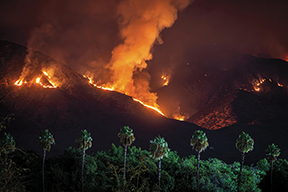
Dear EarthTalk: Is it true that wildfires are changing due to various man-made and natural factors and what can we do to adapt our control and prevention efforts? – Nick Maloney, via email
Wildfires were once seasonal and somewhat predictable. Now they have shifted, and are more destructive, harder to contain and less predictable. Wildfires have helped increase biodiversity and growth by clearing dead vegetation in ecosystems. But recent years, they’ve become more threatening to ecosystems and living beings—more intense, burning longer and affecting areas that previously rarely had wildfires.
This pattern change in wildfires has been driven by a multitude many factors. Natural factors like wind patterns, climate variability and droughts have always influenced the development of wildfires. But man-made factors, like climate change, deforestation and urban sprawl, are worsening the spread of wildfires. The changes “that we have seen in many places in the world [are] caused by the interaction between human-caused climate change and the history of land management leading to more abundant and more connected fuels,” according to Amy Hessl, a geography professor and paleoclimatologist at West Virginia University. Furthermore, Corey Hogan, Canada’s Parliamentary Secretary to the Minister of Energy and Natural Resources, has asserted that “increasingly fires are an all-year event…”
Also, the change in wildfires has been massive. In Spain, some 382,000 hectares have burned this year alone. This number is the highest in records starting from 2006. The 2025 Palisades fires were the costliest natural disaster in the first half of the year. The consequences for human health have also grown. A study funded by the European Commission, and others asserts that the mortality rate from short-term wildfire smoke exposure has been underestimated by 93 percent.
Many traditional mitigation strategies, like land management through controlled burns, community preparedness and education, and fire suppression, have been used to control and prevent wildfires. As wildfires become more challenging to mitigate, technology like satellite monitoring and early detection systems has come into play. Fire strategies must be adapted based on future predictions, forest management must be improved, fire forecasting must consider climate predictions, policies have to be strengthened, and action should be coordinated.
Citizens can play a role in mitigating the risks of these changing wildfires. By educating ourselves on the nature of wildfires, we can enhance our preparedness. We must also support wildfire technology networks, as their advancement would be pivotal in our progress. Groups like the American Red Cross, the Natural Conservancy, and Direct Relief all aid in providing wildfire relief and awareness.
MORE INFORMATION: https://www.redcross.org/; https://preserve.nature.org; https://www.directrelief.org.
♦ ♦ ♦ ♦ ♦ ♦ ♦ ♦ ♦ ♦ ♦ ♦
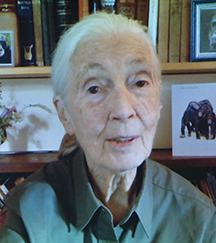
Dear EarthTalk: Everyone knows Jane Goodall was a great conservationist, but what exactly did she accomplish in her lifetime and what will be her legacy? – Winnie Marcus, Wilmington, DE
Jane Goodall was an English anthropologist and primatologist. Around the world, she was most known for her 65-year-long study of wild chimpanzees. She pioneered the research on chimpanzees and completely transformed our view of the species. Before her passing in October 2025, she had dedicated her life to being a global advocate for human rights and environmental protection, even starting a youth empowerment program called “Roots and Shoots.”
Ever since childhood, Goodall loved the outdoors, nature and animals. She was unable to afford college to pursue her passion, but a trip to Nairobi, Kenya to visit a friend allowed her to meet paleoanthropologist Louis Leakey. Eventually, this connection allowed her to get a job at a local museum and later as part of a research team that would travel to Gombe Stream to study wild chimpanzees in Tanzania.
Many challenges, including disease and disagreements with fellow researchers, marked Goodall’s time in this expedition. Still, her commitment to observation and ethical research led the team to realize many breakthroughs that challenged scientific ideals of the time. Her research revealed that chimpanzees are omnivores who hunt for meat, not herbivores as previously thought. She also discovered that chimps use and manufacture their own tools, a trait once thought to be exclusive to humans.
Goodall continued her research at Cambridge University, where many researchers disagreed with her naming the chimpanzees rather than assigning them traditional number designations. This conflict led her to write her recognized book “My Friends, the Wild Chimpanzees.” “‘I thought chimps were so like us but nicer, but they have a dark and aggressive side, just like we do, and they’re capable of violence, brutality, killing and a kind of primitive war,” Goodall said. ‘But also, just like us, they have a loving, compassionate and truly altruistic side, so that an adult male may adopt an orphan whose mother has died. There was this little infant, who was just three and a half, we thought he would die; there was nobody looking after him. And then, to our amazement, a 12-year-old male adopted him, carried him around, shared his food and his nest with him, and saved his life,’ she added.
While this was Goodall’s most well-known work, it was not her last. After receiving her Ph.d, Goodall continued to advocate for wildlife protection and conservation of endangered habitats. As a researcher, Goodall left her legacy on challenging the idea of human uniqueness. Her youth empowerment, reforestation and activism also inspired multiple generations to come together for conservation.
MORE INFORMATION: My Life with The Chimpanzees, https://a.co/d/4qghX8o; https://janegoodall.org/take-action-for-forests-greening-your-community/.
♦ ♦ ♦ ♦ ♦ ♦ ♦ ♦ ♦ ♦ ♦ ♦
EarthTalk® is produced by Roddy Scheer & Doug Moss for the 501(c)3 nonprofit EarthTalk. See more at https://emagazine.com. To donate, visit https://earthtalk.org. Send questions to: question@earthtalk.org.